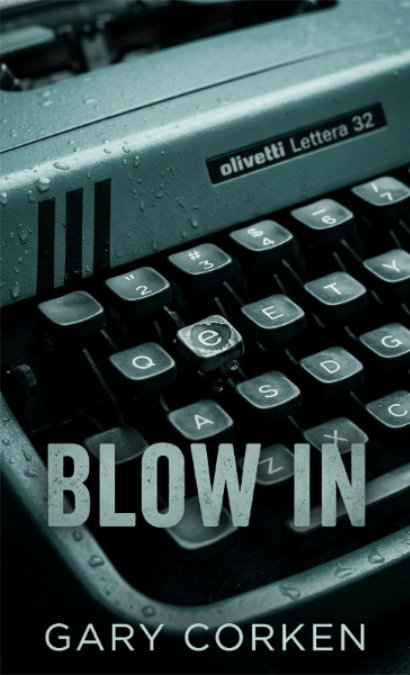
Blow In
In 1970, Aoife Brannan makes a Tuesday delivery to the wrong house at the wrong time. What she sees in that kitchen — a uniformed RUC sergeant sharing tea with men he should be arresting — is the kind of thing that gets people killed in Belfast. She doesn't report it. She leaves.
She leaves Belfast entirely.
By 1984, Aoife has built something quiet on a Devon farm. A different name, a different life, the kind of stillness that takes years to earn. Then a letter arrives typed on a machine she recognises. The 'e' sticks on an Olivetti Lettera 32, and she knows only one man who used that typewriter.
Samuel Crawford has not forgotten what she saw.
Blow In is the story of a woman who has spent fourteen years deciding whether to stay hidden or make the truth visible — and what it costs when she finally chooses.
Sample Chapter
Prologue
Belfast Zoo - June 1969
September 1899
The sun was beating down making the asphalt of the uphill paths smell of tar.
On the bench overlooking the sea lion enclosure, a family sat in the Sunday stillness. The father had his knees apart, holding a melting ice cream away from his trousers. His wife leant towards him, her floral dress a bright patch against the dark wood of the slats. Between them, two small children watched the water, mesmerised by the dark sleek arcs of the animals cutting through the pool.
Twenty yards away, near the railing of the penguin pool, a young man in a denim jacket tried to get a clear shot of his girlfriend. She laughed, her long brown hair blowing across her face as she leant against the iron bars.
‘Hold it there,’ he said, his finger hovering over the shutter of his Pentax. ‘Say cheese.’
‘I look a mess,’ she giggled, shielding her eyes from the glare. ‘Take it quick before I move.’
He twisted the focus ring, the glass clicking as the image sharpened. Through the viewfinder: the girl in the foreground, sharp and vibrant; the grey stone of the enclosure; and further back, the blurred shapes of people on the benches, enjoying the sun.
The shutter snapped, a clean mechanical click lost beneath the cry of a peacock.
‘Got it.’ He lowered the camera and grinned at her, slinging the strap over his shoulder. ‘Perfect light.’
As they passed the bench with the family, the young man gave a small, polite nod to the father still battling the melting ice cream. The man gave a distracted nod back, his mind on his children and the heat.
At the exit, the girl slipped her arm through his.
‘Was the light really that good?’ she asked.
The young man patted the camera casing.
‘Clear as a bell,’ he said.
They disappeared into the stream of people heading for the Antrim Road.
Chapter 1
Belfast
October 1970
The typewriter was an Olivetti Lettera 32, and on cold mornings the 'e' stuck.
Aoife knew how to anticipate it — a slight additional pressure from her left middle finger on the downstroke, enough to push the key through the resistance without breaking her rhythm. It was a small accommodation, a way of working around broken things that she'd practised for three years. There was a newer machine in the stockroom, still boxed, but she never asked for it. The Olivetti's faults were familiar, and in Belfast, familiarity was a form of safety.
Outside, the October rain slanted against the window. The office sat on the first floor above a bookmaker on Springfield Road, and the air in the room was heavy with tobacco and the sweat of the men downstairs. Occasionally the floorboards vibrated with a muffled roar when a race finished and someone got lucky.
The letter she was typing concerned a property dispute. Aoife admired the craft of Pádraig Devlin's prose — courteous and precise, yet heavy with implication. She typed the words and let them pass through her without settling. That was the discipline: type what was in front of you, file what was given, maintain the surface.
She had noticed him watching her once — not the clients, not the door, but her hands on the keys. She'd been transcribing a letter that contained, in its third paragraph, a name that should not have been in any document at all. Her fingers hadn't paused. Her face hadn't changed. She'd typed the name and moved on, and when she looked up, Devlin was already back at his desk. The Tuesday deliveries had started the following week.
Her desk faced the frosted-glass door. The first thing visitors saw, and she'd learned to read them before they reached her. Clients arrived with paperwork and a specific, sharp anxiety. Colleagues arrived with briefcases and bonhomie.
Then there were other people.
They came with nothing in their hands and a stillness in their faces that made Aoife's fingers hover above the keys. They went straight through to Devlin's office, and the door — a solid slab of dark wood — would click shut. She heard only the sound of men deciding things. She remembered the names and addresses from these visits, along with sums of money that moved through accounts in ways that bore no relation to property disputes. She kept this knowledge the way you keep a stone in a coat pocket — aware of the weight, careful not to reach in carelessly.
In the corner sat the locked filing cabinet. Aoife had never seen the key, which Devlin carried on his person, but she knew that whatever was inside was the reason his eyes had changed recently. He'd begun glancing at the cabinet before he left for lunch, the way a man checks a window latch he isn't certain he's fastened.
At half past twelve, she ate her lunch at the desk. A sandwich from home — ham and mustard, wrapped in greaseproof paper. Her mother, Bridget, made two every morning: one for Aoife, one for her brother, Seán. The fact that Seán hadn't taken his lunch in months, or that he often didn't come home at all, did nothing to change the ritual. If you kept the routine, the world might hold its shape.
The afternoon brought Mr Gareth Toner. A small man in a suit that didn't fit, his labourer's hands turning a cap over and over. His son, Declan, being held at Crumlin Road Gaol.
Aoife made him tea — two sugars, no milk, remembered from his first visit. Toner reminded her of her father: the same quality of helplessness, the same hands that didn't know what to do when they weren't working. He sat waiting for Devlin to translate the incomprehensible.
When the rain gathered itself for a fresh downpour, Aoife walked home. The five o'clock walk from Springfield Road to Sorella Street a sensory map of the Falls. She passed the army patrol at Dunville Street — three young English soldiers with rifles held across their chests. Crude, misspelt graffiti scarred the gable walls. Two men stood outside the community centre, motionless for a reason that wasn't her business.
Aoife saw everything and reacted to nothing. Her pace constant, her face neutral. You walked round the soldiers as if they were potholes or rain.
She let herself into the house. It smelt of boiled potatoes and bleach. In the kitchen, Bridget stood with her back turned at the stove, her apron tied tight.
Seán's sandwich sat on the table, untouched. Aoife didn't mention it. She set the table for two.
Later, in the dark of her small bedroom, Aoife listened to the city's nightly percussion: a distant metallic clang, a car door, the bark of a dog. On her windowsill sat three library books and a photograph of her father at Portrush in 1962, grinning with a paper cone of chips in his hand. The only photo in which he looked free.
She thought about the sticking 'e' and the additional pressure required. She thought about the locked cabinet, and Devlin's glance at it, and the particular set of a man's jaw when he has begun to calculate what he might lose.
The lamp went off. In the street below, a dog stopped barking mid-note. Aoife lay in the silence that followed, her eyes open, her hands still at her sides.