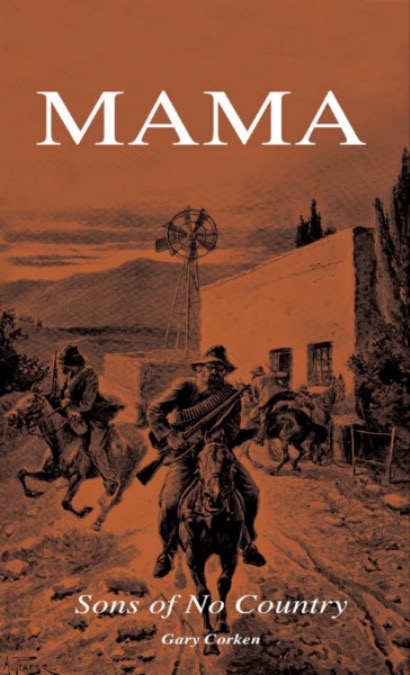
MAMA
In the dark outside a British blockhouse in 1901, an Irish soldier hears a voice crying from the wire.
Mama.
Johannes Erasmus — Rassi — is sixteen years old and bleeding in the veld. He doesn't know his mother is in Bethulie Concentration Camp. He doesn't know that the man who shot him is now deciding whether to leave him there.
Two years earlier, Rassi rode out from Plaas Vergenoeg with his father and the Krugersdorp Commando, certain the war would be short and the Boers would win it. He was wrong about both.
Mama follows one Boer boy's passage from the farm he loved to the wire he couldn't cross — through Talana Hill, Colenso, and the slow grinding war that came after — told from the side of the conflict that history has largely left in silence.
The companion novel to A Violent Shade of Orange. The same battles. The other side of the ridge.
Sample Chapter
Chapter 1
Plaas Vergenoeg
September 1899
Fifteen miles north of Krugersdorp, the highveld opened itself to the sky.
There were no mountains here. No dramatic escarpments or forested kloofs to catch the eye. There was simply the land, the wide red earth running away in every direction under a sky so large it made the horizon feel like a suggestion rather than a boundary. The grass in September was coming back from the dry season, the new growth pushing through the bleached winter stems in thin green lines that would thicken by November into the full rolling grassland that Kobus Erasmus had looked at every morning of his adult life.
Plaas Vergenoeg. Farm Sufficient. His father had named it, and his father had been right.
The farm ran to four hundred morgen of mixed veldt and cultivated ground. Bounded on the east by a low koppie of red sandstone and on the west by the spruit that came down from the higher ground toward Magaliesburg, winding through the farm in a series of wide bends before continuing south toward the Crocodile River. In September the spruit was running well. The summer rains had not yet arrived, but winter's end was releasing the last of the stored water from the higher ground. Cattle had been watering there since first light, the red-and-white Afrikaner cattle that Kobus ran on the eastern pastures and that had been the farm's primary business since his father's time.
A small flock of fat-tailed sheep grazed the slope below the homestead, indifferent as sheep always are to everything that was not immediately underfoot. Two dogs moved between the kraals with the purposeful idleness of dogs that have their work and know it. A pair of kiewiet called somewhere to the south, their cry carrying clean and sharp across the morning air.
The fence line ran along the eastern boundary from the kraal gate to the koppie where the red earth rose briefly before flattening again into the wide indifference of the veldt beyond. Kobus had been meaning to fix the third post since July. September had arrived before he got to it, and now here they were — he and Rassi and Gideon. Working in the thin spring warmth with the tools and the wire and the silence of men working together.
Kobus drove the post. Rassi held it straight, both hands on the wood, his weight against it while his father worked. His eyes moved along the eastern boundary, the veldt receding toward Krugersdorp, the sky above it enormous and clean, the occasional thorn tree breaking the horizon.
Below them, at the bend in the spruit where the bank was low and the approach easy, the cattle were finishing their morning watering. The big red-and-whites moving in the unhurried way of cattle, their breath visible in the last of the morning cool.
Gideon worked the wire further down the line, his broad hands moving with the careful economy of a man who knows what wire can do if you let it get away from you. He had been on Plaas Vergenoeg since before Rassi was born. He moved through its fields and its seasons with the unhurried authority of a man who knows every foot of ground beneath his boots.
Rassi watched his father drive the post into the ground.
His father straightened, looked at the post, and looked at Rassi.
'Goed,' he said.
Rassi let go.
The post held.
By midday the section was done — three posts replaced, the wire re-strung and tensioned, the tools collected and loaded onto the Cape cart. Kobus stood at the completed line, checked his work, and found it satisfactory.
'Eet,' he said to Rassi.
In the furthest field, beyond the eastern boundary, beyond the repaired fence line, a lone camel thorn tree stood against the afternoon sky. Beneath it, marked by a simple cross of ironwood that Kobus had cut and shaped and driven himself eighteen years ago, Pieter Erasmus lay in the red earth of the farm he never did come home to.
Kobus did not look at the tree.
He picked up the post driver and carried it to the cart.
Rassi ate standing at the table and then took the bread and the last of the biltong through to the front room and sat in the chair by the window. He picked up his book from where he had left it two days ago.
Die Geskiedenis van ons Land in the Taal van ons Volk.
He had read it twice already. He was reading it again because du Toit's words had a quality that demanded return, that gave you something different each time you came back to them.
He found his page.
The house was quiet around him. Somewhere in the back, Esther moved through her afternoon work with the steady rhythm he had been hearing all his life.
He turned another page.
The afternoon light shifted. A horsefly moved against the window glass.
Rassi read.
He heard the hoofbeats before he heard the voice.
A single horse coming fast on the track from the Krugersdorp road, faster than a neighbour's visit, faster than a delivery, the urgency of a horse being ridden by someone with no time to waste getting there.
Rassi looked up from his book.
Through the window he could see his father at the kraal gate, Gideon beside him, both of them turning toward the track. The rider came around the bend in a dust cloud, a young man on a bay horse, riding hard, his hat pushed back, already shouting before he had pulled up.
Kommando! Kommando!
The word arrived in the quiet farmhouse like a stone dropped into still water.
Rassi sat very still for a moment.
He looked down at the page he had been reading. Du Toit's words about the Boer people, their history, their sacrifice, their God-given right to this land, looked back at him from the page with a different weight than they had carried thirty seconds ago.
He looked out the window at his father already moving toward the house.
He looked back at the page.