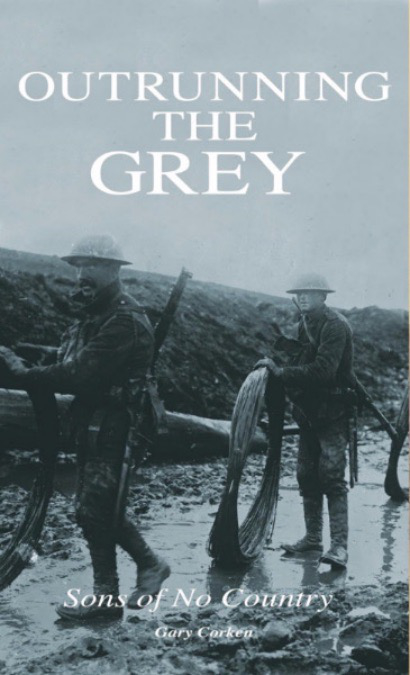
Outrunning the Grey
In 1915, Alfred Moore walks off HMHS Drina at Chatham and does not look back. He has his reasons. He keeps them to himself.
What he can't outrun is the war. A false name gets him into the Royal Irish Rifles. The 14th Battalion gets him to the Somme. And on the 1st of July 1916, the Schwaben Redoubt gets him in a way that nothing before it managed.
Alfred survives things that should have finished him — the Somme, the sinking of the Carthage, the slow machinery of a country that has no use for men like him. He reinvents himself more than once. Canada seems like the last reinvention.
Outrunning the Grey is the story of a man who keeps moving and the past that keeps pace.
A man under a false name and what that costs him on the Somme. The 14th Royal Irish Rifles at the Schwaben Redoubt, 1 July 1916. Survival, reinvention, and Canada that is not the last reinvention.
Sample Chapter
Chapter 1
Belfast
Friday 14th August 1914
Alfred Moore was nineteen years old and had been working his father's foundry floor since he was old enough to lift a ladle. On a Belfast August, with the city in the grip of a heatwave, the foundry was close to unbearable. The air was thick with scorched sand and the metallic tang of molten iron. A fine coating of sulphur and sweat stayed on his skin long after the whistle blew.
Thomas stood at the head of the floor. He didn't need to shout to be heard over the roar of the furnaces — he was simply a man the floor moved around. A calloused finger pointed and the men moved. If Thomas frowned, the men around him worked with a frantic, silent desperation, watching the ladle as if their lives depended on a clean pour.
Alfred felt his father's stare tracking the tremor in his forearms. His knuckles turned white as he fought the iron handle, but the vibration in his bones wouldn't be stilled.
'You're losing the line,' Thomas barked, stepping closer. 'Shift your weight.'
The ladle tilted, the molten surface slopping toward the rim. Alfred looked at the orange glow reflecting in the soot of the floor, the same pattern of spill and spark he had watched since he was ten. He thought of his father's hair, already the colour of furnace ash, and the way the old man's shoulders had set into a permanent iron curve.
He let go. The ladle hit the floor with a clang that vibrated through the soles of his boots. The molten iron spilled, a bright orange against the grey dust, eating into the grey dust.
'Walk out now,' Thomas said, his voice dropping. 'And you'll be a ghost to me.'
Alfred turned toward the exit. The air outside was thin and tasted of nothing.
At the house, the gas mantle hissed in the kitchen, throwing long shadows against the wall. He packed a rough canvas sack: a spare shirt, a heavy coat. His mother stood in the kitchen doorway, her hands twisted in her apron, her eyes fixed on the empty chair at the head of the table.
Alfred paused at the threshold. He searched her face for a command or a plea, but she remained still.
Mary reached into her apron and produced a small roll of crumpled notes — savings kept away from the jar on the mantel. She pressed them into his palm, her fingers rough and cold.
'Just take it,' she said. She went into the front room and returned with her Bible, sliding it into the sack. 'Always remember who you are, son. Even if you have to find it somewhere else.'
He stepped out into the dreich and dark of a Belfast night.